


























Catalog Management
Enterprise Procurement Catalog Management


























Make Buying at Work as Simple as Buying Anywhere Else
Employees across the enterprise purchase goods and services every day - office supplies, IT equipment, MRO materials, professional services, software subscriptions. Yet in most organizations, the process for buying a laptop or ordering safety gloves involves raising a manual requisition, waiting for someone in procurement to identify the right supplier, negotiating pricing, and then processing a purchase order. For a routine, repeat purchase; this cycle can take days or even weeks.
The result is predictable. Employees bypass procurement entirely. They purchase directly from suppliers using corporate cards, raise ad-hoc requests outside the system, or simply choose whichever supplier responds fastest - regardless of negotiated pricing or approved supplier lists. This maverick spend erodes the savings procurement has already negotiated; fragments spend data and creates compliance gaps that surface during audits.
The root cause is not employee non-compliance. It is the absence of a buying channel that is fast enough, intuitive enough, and well-stocked enough that employees prefer to use it.

What is Procurement Catalog Management?
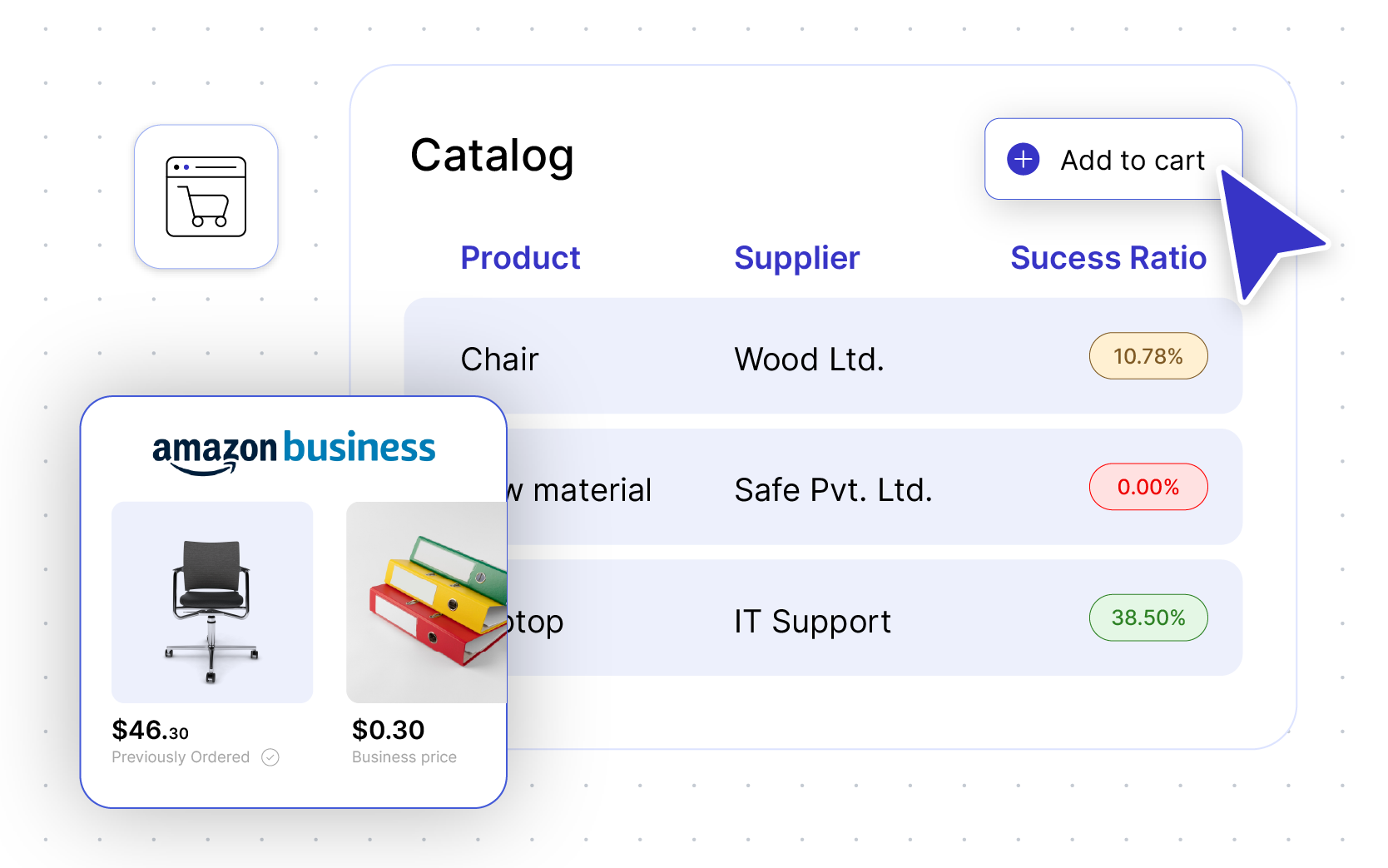
Procurement Catalog Management is the process of creating and governing a digital catalog of pre-approved goods and services that employees can browse and order directly - without initiating a new sourcing cycle for every purchase.
Items in the catalog are already sourced, negotiated, and contracted. When an employee selects an item, the system automatically generates a compliant requisition, applies the correct approval workflow, and routes the order to the contracted supplier - functioning as an internal marketplace with built-in governance.
Within the Source-to-Pay lifecycle, catalog management bridges strategic sourcing and operational purchasing - ensuring that the value created during sourcing and contracting is captured at the point of every transaction:




How SAFAL Catalog Management Works?

Consumer-Grade Search and Discovery
- Category browsing, keyword search, filters
- Item descriptions, images, and pricing
- AI recommendations for preferred items
- Quick reordering of frequent purchases

Guided Selection and Cart Experience
- Add-to-cart with quantity and delivery details
- Dynamic forms by category, value, entity
- Budget checks before submission
- Cost allocation to cost center, project, or GL code
Automated Approval and Order Routing
- Approval workflows by category and value
- Auto-approval within defined thresholds
- Automatic PO generation and supplier dispatch
- Real-time approval and order notifications

Order Fulfilment and Shipment Tracking
- Order confirmation and delivery timelines
- Goods receipt and service confirmation
- Exception handling for delayed or incorrect deliveries
- Handoff to invoice matching and payments

Catalog Governance and Maintenance
- Item activation, deactivation, and updates
- Supplier-managed content with procurement approval
- Pricing refresh linked to contract renewals
- Coverage analytics for uncatalogued categories
- Adoption tracking across entities and units
Key Capabilities









Why SAFAL Catalog Management
- Hosted catalogs, punch-out catalogs, and free-text requests managed in one environment
- AI-powered recommendations that surface preferred items and contracted suppliers
- Native integration with SAP, Oracle, Microsoft Dynamics, and Navision
- Connected to sourcing, contracts, approvals, and invoice matching within the same platform
- Catalog governance tools for pricing updates, coverage analysis, adoption tracking
Transform Routine Purchasing with
SAFAL Catalog Management
Without Catalog Management
- Employees raise manual requisitions for routine items
- Procurement processes every low-value purchase manually
- Negotiated pricing is bypassed when employees buy off contract
- No visibility into what employees are buying outside the system
- Suppliers manage catalogs through emails and spreadsheets
- Procurement teams cannot measure catalog adoption or coverage
With SAFAL Catalog Management
- Self-service ordering from a pre-approved digital catalog
- Auto-approval and automated PO for catalog orders within thresholds
- Contracted pricing and approved suppliers enforced at every checkout
- All purchases - catalog and non-catalog - captured and categorized
- Supplier content managed through structured updates with procurement approval
- Analytics track adoption rates, spend coverage, and catalog health
Types of Catalogs Supported
Benefits for Enterprise Procurement Teams

Reduce Maverick Spend
Improve Spend Data Quality

Capture Negotiated Savings at Point of Purchase

Free Procurement from Low-Value Processing
Give Your Teams a Better Way to Buy

"Very Helpful for proactive spend control"
Director, Finance